St. Teresa of Avila
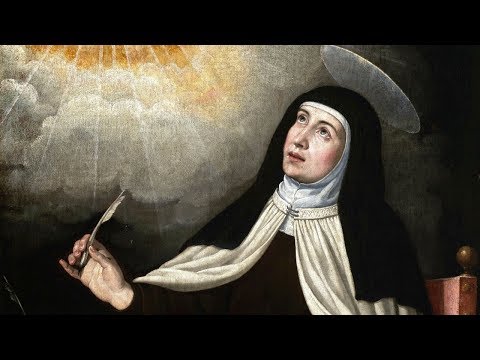

Facts
Patron: of Headache sufferers, Spanish Catholic Writers
Birth: March 28, 1515
Death: October 4, 1582
Beatified: April 24th 1614, Rome by Pope Paul V
Canonized: March 12th 1622, Rome by Pope Gregory XV
Author and Publisher - Catholic Online
Printable Catholic Saints PDFs
Shop St. Teresa of Avila
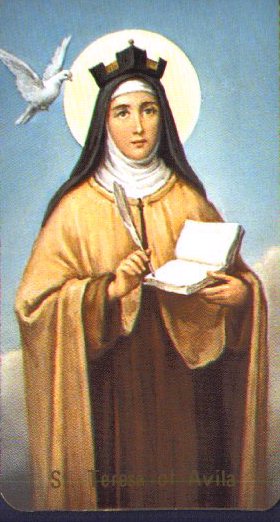
Born on March 28, 1515, in either Ávila or the nearby town of Gotarrendura, Saint Teresa of Ávila entered the world at a time of deep religious upheaval and renewal in the Church. She was born into a devout and noble Spanish family. Her father, Alonso Sánchez de Cepeda, was a successful merchant of strong Catholic conviction, and her mother, Beatriz de Ahumada, nurtured in Teresa a love for God from an early age. As a child, Teresa was captivated by the lives of the saints, and her heart burned with a desire for holiness so intense that at the age of seven she attempted to run away with her brother in hopes of dying a martyr for Christ.
The death of her mother when Teresa was fourteen left a lasting impression on her soul, leading her to entrust herself more fully to the Blessed Virgin Mary as her spiritual mother. Though she was sent to be educated by the Augustinian nuns, Teresa struggled, like many young people, with the pull of worldly interests. Yet beneath this struggle, God was preparing her for a deeper calling. At the age of twenty, after much interior conflict, she entered the Carmelite Convent of the Incarnation in Ávila, choosing a life dedicated to God despite her natural hesitations.
Her early years in religious life were marked by spiritual inconsistency. The convent itself had grown relaxed in discipline, and frequent social visits disrupted the silence necessary for deep prayer. Teresa later admitted that her heart was divided between God and the world. It was through suffering that God began to draw her closer. A serious illness left her bedridden for nearly a year and brought her to the brink of death. During this time, she turned more fully to prayer and spiritual reading. The writings of Saint Augustine of Hippo, especially his Confessions, helped her understand that even those who struggle can become saints.
After her recovery, Teresa experienced a profound and lasting conversion. She began to practice mental prayer with renewed dedication and gradually entered into deeper forms of union with God. Over time, she was granted extraordinary mystical experiences, including visions of Christ and moments of deep spiritual ecstasy. Among the most well-known of these was the transverberation, in which she described an angel piercing her heart with a fiery spear, filling her with both intense pain and an overwhelming sweetness of divine love. These experiences, though questioned by some, were affirmed by wise spiritual directors and bore lasting fruit in her holiness.
As her relationship with God deepened, Teresa became increasingly aware of the need for reform within her religious community. She saw clearly that the Carmelite life had lost much of its original fervor and simplicity. Moved by a desire to restore a life of prayer, poverty, and silence, she set out to found a new kind of convent. In 1562, she established the Convent of St. Joseph in Ávila, embracing a stricter observance rooted in contemplation and total dependence on God. Though her efforts were initially met with suspicion and resistance, her trust in God never wavered.
Her reform soon spread beyond a single convent. With the help of Saint John of the Cross and other collaborators, Teresa helped establish the Discalced Carmelites, a renewed expression of Carmelite life committed to prayer and sacrifice. Over the course of twenty years, she traveled tirelessly across Spain, often in poor health and under difficult conditions, founding seventeen convents for women and supporting the establishment of monasteries for men.
This work was not without suffering. Teresa faced opposition from members of her own order, misunderstandings, and even formal restrictions on her ability to continue her foundations. At one point, she was ordered to cease her work and withdraw into one of her convents. Yet through humility, obedience, and perseverance, she continued to trust in God's providence. With the eventual support of Church authorities and the Spanish crown, her reform was allowed to continue and flourish.
Alongside her work as a reformer, Teresa became one of the Church's greatest spiritual writers. Her autobiography, The Life of Teresa of Jesus, recounts her journey of conversion and prayer. In The Way of Perfection, she offers practical guidance for those seeking to grow in holiness. Her masterpiece, The Interior Castle, describes the soul as a castle with many dwelling places, leading ultimately to union with God at its center. Through these works, she teaches that prayer is not reserved for a few, but is the path by which every soul can encounter the living God.
In her later years, Teresa continued her mission despite increasing physical weakness. While traveling to found yet another convent, she fell ill. In 1582, her earthly journey came to an end. Her final words reflected the deep love that had guided her entire life: "My Lord, it is time to move on... the hour that I have longed for has come." Because of the reform of the calendar that same year, her death is recorded as occurring on either October 4 or October 15, the latter now celebrated as her feast day.
Forty years after her death, she was canonized by Pope Gregory XV, and centuries later, in 1970, Pope Paul VI declared her a Doctor of the Church, making her the first woman to receive this title. This honor recognized not only her holiness, but the enduring wisdom of her teaching.
Saint Teresa of Ávila's life stands as a powerful witness to the transforming love of God. Through suffering, perseverance, and unwavering trust, she discovered that the deepest truth of the Christian life is found in prayer. Her words continue to echo through the centuries, inviting every soul into that same intimacy with God: let nothing disturb you, let nothing frighten you, all things are passing, God alone suffices.

Come Grow With Us
Sign up and walk the Catholic journey with millions around the world.
Receive inspiring emails on saints, daily readings, and free faith-building resources—no cost, ever.
Easter Was Just the Beginning - Please Watch
- Easter / Lent
- 5 Lenten Prayers
- Ash Wednesday
- 7 Morning Prayers
- Mysteries of the Rosary
- Litany of the Bl. Virgin Mary
- Popular Saints
- Popular Prayers
- Female Saints
- Saint Feast Days by Month
- Stations of the Cross
- St. Francis of Assisi
- St. Michael the Archangel
- The Apostles' Creed
- Unfailing Prayer to St. Anthony
- Pray the Rosary





Copyright 2026 Catholic Online. All materials contained on this site, whether written, audible or visual are the exclusive property of Catholic Online and are protected under U.S. and International copyright laws, © Copyright 2026 Catholic Online. Any unauthorized use, without prior written consent of Catholic Online is strictly forbidden and prohibited.
Catholic Online is a Project of Your Catholic Voice Foundation, a Not-for-Profit Corporation. Your Catholic Voice Foundation has been granted a recognition of tax exemption under Section 501(c)(3) of the Internal Revenue Code. Federal Tax Identification Number: 81-0596847. Your gift is tax-deductible as allowed by law.